
- Best for
- Players who enjoy decisions
- Reading time
- About 9 minutes
- Skill level
- Beginner to intermediate
- Key tool
- A written bankroll plan
Key takeaways
- Texas Hold’em is learned in minutes but rewards patience and position for years.
- Memorise the hand rankings so you never misread the board under time pressure.
- Rake is the house’s cut; check the lobby or table info for how it is charged.
- Keep 20–40 buy-ins for cash games and far more for tournaments.
- Poker still involves real risk; set limits with our JUAN365PH responsible gaming tips.
On this page
Poker is different from almost everything else in an online casino. In slots, roulette or baccarat you play against the house’s maths. In poker you play against other people, and the house simply takes a small fee for running the table. That means your decisions genuinely matter, which is exactly why so many of us fell in love with the game during long nights with the barkada and a deck of cards.
In this guide I cover the essentials for playing online poker on JUAN365PH, assuming the poker lobby is available to you: Texas Hold’em rules, hand rankings, why position matters, how rake works, the difference between cash games and tournaments, bankroll rules, and the beginner mistakes I made so you do not have to. If you have not set up your account yet, our JUAN365PH register and login guide walks you through it.
Texas Hold’em in two minutes
Texas Hold’em is the most popular poker variant in the world, and it is almost certainly what you will see first in any online poker lobby. Each player receives two private cards, called hole cards. Five community cards are dealt face up in the middle in three stages, and you make the best five-card hand from any combination of your two cards and the five on the board.
- Blinds: the two players to the left of the dealer button post forced bets, the small blind and big blind.
- Pre-flop: everyone gets two cards and a round of betting starts with the player left of the big blind.
- Flop: three community cards are dealt, followed by a betting round.
- Turn: a fourth card, then betting.
- River: the fifth and final card, then a last betting round.
- Showdown: remaining players reveal their hands and the best one wins the pot.
On each betting round you can check (if no one has bet), bet, call, raise or fold. Most online tables are no-limit, meaning you can bet all your chips at any time. That is exciting, and also why discipline matters.
Poker hand rankings
Learn this table until it is automatic. Online tables move quickly and timers are short, so you do not want to be second-guessing whether a flush beats a straight. For a deeper reference including odds, see the list of poker hands on Wikipedia.
| Rank | Hand | Example | What it means |
|---|---|---|---|
| 1 | Royal flush | A♠ K♠ Q♠ J♠ 10♠ | Ace-high straight, all one suit |
| 2 | Straight flush | 9♥ 8♥ 7♥ 6♥ 5♥ | Five in sequence, same suit |
| 3 | Four of a kind | Q Q Q Q 4 | Four cards of one rank |
| 4 | Full house | J J J 8 8 | Three of a kind plus a pair |
| 5 | Flush | K♦ 10♦ 7♦ 4♦ 2♦ | Five of one suit, not in sequence |
| 6 | Straight | 8 7 6 5 4 | Five in sequence, mixed suits |
| 7 | Three of a kind | 7 7 7 K 2 | Three cards of one rank |
| 8 | Two pair | A A 9 9 3 | Two different pairs |
| 9 | One pair | 10 10 K 6 3 | Two cards of one rank |
| 10 | High card | A J 8 5 2 | None of the above |
When two players have the same hand type, the higher cards win, and leftover cards (kickers) break ties. Suits never rank above each other in standard Hold’em.
Position: the free advantage
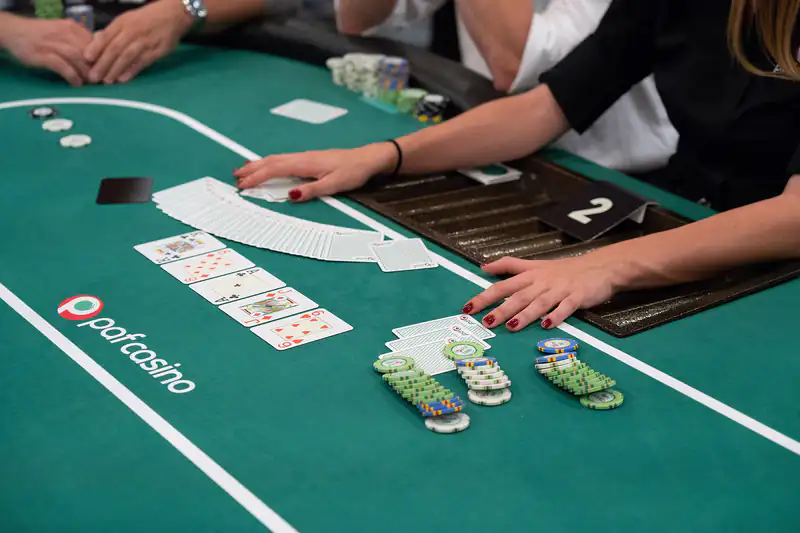
Where you sit relative to the dealer button changes how you should play. Acting last means you see what everyone else does before you decide, which is a huge information edge.
- Early position (first to act after the blinds, often called “under the gun”): play only strong hands such as big pairs and high suited aces.
- Middle position: open up slightly, adding hands like medium pairs and strong suited connectors.
- Late position (the cutoff and the button): you can play a wider range because you act last on every street after the flop.
- The blinds: you have money already invested, but you act first after the flop, so avoid defending with weak hands.
.jpg)
Rake: how the house gets paid
Because poker players compete against each other, the operator earns through rake. In cash games this is usually a small percentage taken from each pot, often with a maximum cap per hand, and many rooms follow a “no flop, no drop” rule. In tournaments, rake is built into the entry fee, for example a buy-in shown as “₱500 + ₱50”.
Rake structures vary between rooms and stakes, so I will not quote figures for JUAN365PH. Check the table information or the lobby help section before you sit down. At micro stakes, rake can eat a meaningful share of what winning players earn, so it is worth understanding even as a beginner. It also means that, in expected value terms, the player pool as a whole always loses a little to the house.
Cash games vs tournaments
Both formats use the same hand rules but feel very different.
- Cash games: chips represent real money, you can buy in and leave whenever you like, and the blinds stay fixed. Great for short, controlled sessions.
- Tournaments: you pay a fixed entry, everyone starts with the same chips, and blinds rise over time until one player has everything. Prizes go to the top finishers. They can last hours.
- Sit and go’s: small tournaments that start once enough players register, usually one table, a decent middle ground.
If your evenings are short or you get interrupted a lot, cash games are kinder to your schedule. Registering for a long tournament and then having to leave means blinding away your stack.
Bankroll rules that keep you in the game
Your poker bankroll is money set aside only for poker, separate from rent, food and family obligations. Even skilled players hit long losing streaks, simply because of card variance.
- Cash games: keep at least 20–40 full buy-ins for the stake you play. If a buy-in is ₱1,000, that means ₱20,000–₱40,000 set aside before you play that level regularly.
- Tournaments: variance is much higher, so 50–100 buy-ins is a common guideline.
- Move down quickly: if your bankroll drops below your rule, drop a level. Ego is expensive.
- Never top up from essentials. If the poker money is gone, the session is over.
To keep deposits and withdrawals deliberate, read our JUAN365PH GCash and Maya deposit guide.
Beginner mistakes to avoid
- Playing too many hands. Folding is not boring; it is how good players save money.
- Calling too much. Calling down with a weak pair “to see” is the most expensive habit in poker.
- Tilting. After a bad beat, take a break. Believing you are “due” for good cards is the gambler’s fallacy at the felt.
- Multi-tabling too early. Learn on one table before adding more.
- Ignoring position. The same hand can be a raise on the button and a fold under the gun.
- Bluffing beginners. At low stakes, many opponents call too often; value betting your good hands usually works better.
A simple plan for your first session
When I teach friends the game, I give them the same short routine. It keeps the first few sessions calm, cheap and educational, which is exactly what you want while the rules are still sinking in.
- Pick the lowest stake available in the lobby, even if it feels too small. The goal is learning, not winning.
- Sit at one table only and turn off any distractions, including the TV and group chats.
- Play tight: mostly pairs, strong aces and big suited cards, and fold the rest without regret.
- Write down three hands after the session that confused you, then review them with the hand rankings table above.
- Stop after a fixed time, for example 45 minutes, win or lose.
Online poker on a phone is very playable, but small screens make misclicks easy. Our JUAN365PH mobile app guide has tips for a cleaner setup, and if you want a break from decision-heavy games, the JUAN365PH live casino guide explains slower table games. You can see the main categories on our JUAN365PH games page, and quick answers to common account questions are in the JUAN365PH FAQ.
Playing safely and legally
You must be 21 or older to play. Online gaming in the Philippines is overseen by PAGCOR, and it is worth checking any operator’s licensing claims against official sources yourself. Our JUAN365PH safety checklist explains how. For broader limits and warning signs, visit our responsible gaming page, and read our disclaimer and affiliate disclosure to understand how this site works. More guides are in the JUAN365PH Guide blog, and you can learn about me on my author page.
Frequently asked questions
Does JUAN365PH have online poker?
Game lobbies can change over time, so check the current list of games after logging in. Our JUAN365PH games overview describes the main categories.
What poker hand beats a flush?
A full house, four of a kind, a straight flush and a royal flush all beat a flush. A flush beats a straight.
How much money do I need to start playing poker?
Start at the lowest stakes and keep at least 20–40 buy-ins for cash games. Only use money you can afford to lose.
Is poker a game of skill or luck?
Both. Skill matters over many hands, but luck dominates short sessions, and rake means most casual players lose over time.
Keep reading
- JUAN365PH Live Casino Guide 2026: Baccarat, Roulette, Sic Bo, Blackjack and Dragon Tiger
- JUAN365PH Responsible Gaming Tips 2026: Budgets, Limits, Warning Signs and Where to Get Help
- JUAN365PH Slots Guide 2026: RTP, Volatility, Features and Smart Bet Sizing
- Browse all JUAN365PH guides
AI-assisted content: This article was drafted with the help of AI writing tools, then reviewed, fact-checked and edited by Jose Rodriguez. Games, payment options and promotions change — always confirm current details on the operator’s own pages and with PAGCOR. 21+ only. Read our editorial policy.